

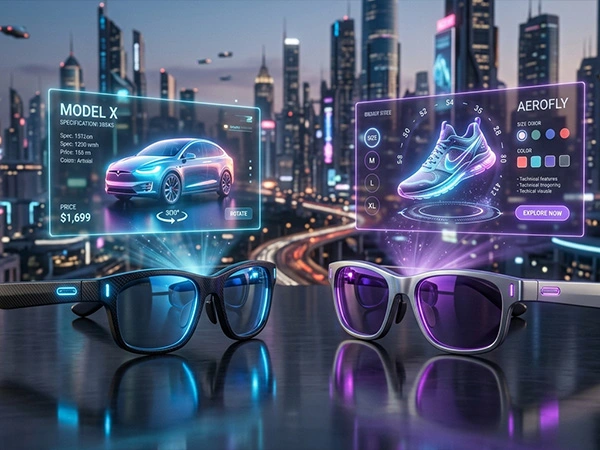
The advent of e-commerce was challenging until individuals could visualize it. With AR advertising trends, buyers can try it on digitally. Whether it’s about power glasses from Lenskart or furniture available on Amazon, AR specs allow the individual to visualize the product.
According to GrandViewResearch, the augmented reality market was estimated at USD 120.21 billion in 2025 and projected to reach USD 1,050.56 billion by 2033. Today, shopping is not just about scrolling through popular e-commerce sites but is more about wearing Meta AR glasses.
The shift in Meta AR Ads strategy revolves around personalized product recommendations. As per Grabon.in, Users engage with Snapchat’s AR Lenses over 8 billion times per day.
In this blog, we will tell you everything regarding Snap AR specs launch targeting 2026 consumers. By the end of your read, you will know what exactly AR advertising trends are.
Key Insights
- According to IMARC, the AR advertising market is exploding, having reached USD 2.8 billion in 2024 and is projected to reach USD 49.6 billion by 2033. It is exhibiting a CAGR of 33.50 during 2025-2033.
- 2026 has brought a 360-degree shift in individual buying behavior. The snap consumer specs launch and Meta’s continued push make this year the year Meta AR ads strategy goes mainstream.
- As per Omdia, Meta’s AI glasses shipment in 2025 reached 4 million units. Accounting 80% of the market share.
- Top brands like NIKE, IKEA, Sephora, and Amazon use AR to reduce product returns and significantly boost engagement.
- With AR Marketing 2026, the brands bring highly shareable content. Hence, it is more likely to share a unique and immersive experience.
The AR Advertising Revolution – Why 2026 Changes Everything

Augmented Reality has been part of our daily lives for a long time. Pokémon Go in 2016 to Sephora try-on makeup on mobile, everything is influenced by AR advertising trends. Affordable yet wearable AR glasses that people actually want to wear, not chunky headsets.
AR Marketing 2026 revolved around the following:
Hardware Availability
Snap AR Specs Launch at Expo 2025 was lightweight and immersive. These glasses are integrated with an ultra-powerful computer lens. It enhances physical experiences with digital ones.
AI Makes AR Actually Useful
AR specs features deep integrations with OpenAI and Gemini on Google Cloud. Meta AR ads strategy involves real-time translation of street signs or furniture guidance overlaid in the drawing room.
Consumers are Ready
As per Statista, in 2025, there were 1.07 billion mobile AR users, and it is expected to jump to 1.19 billion by 2028. These AR advertising trends are reshaping the buying tendency and boosting the AR spatial competition.
Snap AR Specs Launch – The Developer First AR Gambit
Snap AR Specs Launch represents the social native AR advertising platform. Meta was focused on building a consumer product first, but Snap spent years building a developer ecosystem. Hence, it is paying off.
What Makes Snap Specs Different
According to the newsroom.snap, snap has spent 11 years and more than $3 billion to invent a new type of computer for augmented reality. It provides a 46 ° field view and is integrated with OpenAI and Google Gemini.
What Sets Snap Apart:
-
Standalone Power
No need for a phone, no tethering, and no puck is required. Everything runs on the glasses themselves. Snap AR Specs Launch is powered by Qualcomm Snapdragon XR chips.
-
Developer Ecosystem
Before the launch of AR specs to consumers, developers were creating real-world applications:
Super travel from Gowaaa helps to translate signs, menus, receipts, and real-world applications.
Cookmate from Headraft finds recipes based on available ingredients and provides step-by-step cooking assistance.
-
AI Integration
The depth module API translates 2D information from larger language models to anchor AR information accurately in three dimensions.
Hence, unlocking a new paradigm of spatial intelligence. At the same time, the Augmented Speech Recognition API enables real-time transcription with support for 40+ languages.
AR advertising trends every marketer should watch
Virtual Try-on Takeover Retail
According to Brand XR, Sephora AR mirror trials led to an estimated 31% increase in sales. It led to an increase in conversion rates by 90% higher.
It gives consumers the confidence to purchase cosmetics online and eventually boosts engagement.
IKEA pioneered this with its Place app. IKEA’s AR-powered app allows users to place 3D furniture models in their homes. Hence, it gives a realistic view of how furniture fits before the purchase.
Location-based AR Campaign
Augmented reality glasses to stimulate location-specific advertising, which mobiles could never do.
Snap AR specs launch is enriched with major features like guided navigation, which allows AR guided tours.
AR Advertising Trends – Snap Specs vs. Meta

Billboards of AR marketing 2026 are not static anymore; they are shifted from flat screens to immersive overlays.
According to counterpoint analysis, global AR smart glasses shipments rose 98% year on year.
How to Choose Between Snap Specs and Meta Glasses
-
Demographic and Engagement Edge
Choose snap to capture Gen Z and young millennials. Snap specs are used for a high-engagement, shareable AR experience that transforms a passive viewer into an active participant.
-
Scalability and Infrastructure
Choose Meta glasses for unparalleled reach. It is leveraging the existing Facebook and Instagram. Meta provides proven ROI and seamless integration into existing social campaigns.
-
Hardware Philosophy
Snap AR Specs Launch provides a pure AR experience with virtual try-on displays. While Meta dominates the smart wearable market through smart and camera utility software.
-
Future Breakthrough
According to ResearchAndMarkets, the global market of smart Augmented reality glasses was sized at 1 million units in 2024. It is projected to reach 13.8 Million Units by 2030.
AR advertising trends focus on moving toward real-time, contextual ads that overlay digital data onto the physical world.
Why Choose UNV Digital as Your AR Advertising Partner
UNV Digital is transforming AR advertising trends with hands-on experience in 3D integration across various domains.
We have helped their prominent clients to grow across emerging advertising technologies before they became the top leaders.
Our qualified team follows the structured AR marketing. From creative production for snap lenses, meta AR experiences, to WebAR.
We do performance optimization across both Snap and Meta platforms. Our ultimate aim is to keep our premium clients ahead.
While some people are still reading about AR, we can have your first campaign live.
Fed up with scrolling through AR advertising? Contact us. We will turn your ad spend into an immersive and high-converting experience!
FAQs
-
Why should I invest in AR advertising now instead of waiting?
Early adoption of the latest technology is not a choice but a chance to lead the future. AR advertising trends establish organizational expertise. AR-driven ad costs are relatively affordable now, but they can increase when more advertisers come into the competition.
-
Which industries benefit most from AR advertising?
Retail industries are leading with AR advertising. Majorly, fashion, beauty, furniture, home decor, etc., get immediate benefits with virtual try-on and visualization. If the customers benefit from seeing, trying, or interacting with a product before buying, it means AR advertising is working.
-
Can small businesses compete with big brands in AR advertising?
Yes, the meta AR ads strategy does not have a big budget. But it is about creativity and utility. A local eyewear shop can implement AR try on for a fraction of what big brands spend on TV commercials. WebAR experiences are accessible even on small budgets. Hence, one strong AR experience can solve customer problems, prove ROI, and scale across various domains.
