

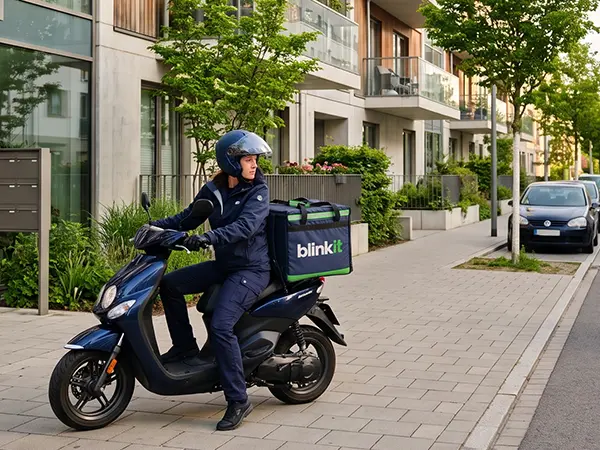
City life is increasingly impatient; people who once waited months for particular products now won’t wait even 10 minutes. Dark Store Quick Commerce has brought a paradigm shift in the shopping ecosystem. According to The Economic Times, the quick commerce market is projected to hit ₹1.08 lakh crore in 2026, growing at 40% YoY.
Behind every 10-minute delivery is a Dark Store, and behind every Dark Store is Hyperlocal Ads. The ad engine decides exactly what an individual can see in a particular pincode at a particular moment.
Dark Store is a small, shopper-invisible micro-warehouse positioned within a few kilometers of the dense urban population. According to Tenovia-solutions, Dynamic Product Ads sync with real-time dark store inventory and outperform static campaigns by 40-60%.
In this blog, we will explain how Dark Store Quick Commerce Marketing works and how Hyperlocal Ads are different from traditional digital advertising. Keep reading!
Key Insights
- According to RevQ.in, the entire Quick Commerce industry runs 6,000+ dark stores across India, and each dark store serves a 2-3 km delivery radius.
- Hyperlocal Ads on Blinkit, Zepto, and Instamart convert faster because they hit ready-to-buy customers inside the same 10-minute session.
- As per ladya.in, the average ROAS across Blinkit, Instamart, and Zepto is 3.5 to 5X, or 1.3 to 2.2X after COGS and commissions.
- Impulses meet inventory; then there is a significant shift in Hyperlocal Delivery Platform Advertising. Hyperlocal market delivery is projected to grow at a 22% CAGR from 2026 to 2030, as per Makreo Research and Consulting.
What is Dark Store Quick Commerce Marketing?
1] Purpose-Built Micro Warehouses
A dark store is a local fulfillment network built for online orders, with no foot traffic or checkout counters, and inventory designed to optimize quick order picking.
2] Hyper-Local Delivery Radii
Unlike traditional retail or standard e-commerce, each hub operates within a tight 2-3 km catchment zone.
3] Pincode-Level Brand Visibility
Brand presence on quick commerce apps is entirely binary. If the SKUs are not physically stocked in the specific dark store serving the user’s pincode, they are not visible to them. The amount of ad spend can solve an inventory gap.
4] Rapidly Expanding Footprint
According to Shadowfax, India operates over 6,000 active dark stores as of early 2026, concentrated in high-density Tier 1 urban clusters.
Why Does Hyperlocal Targeting Bring a Paradigm Shift?
Traditional digital ads reach a metro or a state. A Hyperlocal Delivery Platform reaches a specific neighborhood, sometimes a specific building.
What Makes Hyperlocal Different?
- Real-time Relevance: Today, Quick Commerce brands can respond to local weather and trends. Think of ice cream during a heatwave or soup during a monsoon by syncing ad automation with live inventory APIs.
- Pincode-level Pricing Intelligence: A person in one pincode can see completely different pricing, promotions, and even product availability than the person in another pincode of the same city.
- Session-based Conversion: A buyer who sees a sponsored listing on Blinkit typically buys within the same session, inside the same 10-minute delivery window.
The Advertising Formats Inside Dark Store Quick Commerce
Brands advertising on these platforms typically access a mix of the following:
- Sponsored Search Placements: Bidding to appear at the top category within the app, functionally similar to Amazon sponsored product ads, but it is resolved in a single short session.
- Product Booster and Visibility Packages: Paid placements that push a specific SKU higher in category or recommendation carousels, often sold as fixed packages.
- Swap-and-Save and Comparison Placements: The advertisements that present a brand’s product as an alternative when a consumer looks up or adds a competing brand’s product to their cart. It is the hyper-local equivalent of in-store merchandising.
- Deep-Linked Campaign Creative: Increasingly, brands run off-platform video or social creative with deep links that drop a user directly into a pre-filled cart on Blinkit.
Building a Dark Store Marketing Strategy That Works
- Pincode-level stock check & audit pricing prior to allocating budget on ads; averages at city level do not contain the signals that matter.
- Select the platform that fits best for your category & consumer set; Zepto leans towards dense and younger urban markets, whereas Instamart & Blinkit have wider Tier 2/3 coverage.
- Leverage ads for velocity build and then leave everything organic; Organic ranking is based on sales velocity on these platforms, hence the paid efforts will help you organically rank later.
- Create creative keeping current inventory in mind and not go with the old seasonal ads.
- Measure true ROAS and not ROAS on the platform before increasing budget.
Why Hyperlocal Ads are only as Strong as the Dark Store Behind Them?
Brands planning hyper-local ads usually stop at pin-code level demand and forget to ask who is actually running the dark store fulfilling that order.
That’s a real blind spot, because add performance and fulfillment reliability, and Dark Store Quick Commerce is really the same problem in disguise.
1] Platform-Run vs. Third-Party-Run Stores Don’t Perform the Same Way
- A growing share of dark store capacity is now being operated by third-party logistics partners instead of the platform themselves.
- Some logistics players are simultaneously scaling their own dark store footprint while also handling fulfillment for multiple vertical apps in the category.
- Professionally run and third-party-backed dark stores tend to have tighter slotting, forecasting, and stocking disciplines.
- Thus, they directly determine whether the SKU shown in the ad is actually on the shelf when a shopper taps it.
2] Category Expansion is Shifting where Ad Budget should Follow
- Dark stores were originally built around groceries, but non-grocery categories such as electronics, cosmetics, small accessories, and medicines are now growing faster than food or most apps.
- It is all about handling infrastructure. A skincare bottle or a phone accessory needs sturdier packaging and more careful picking than a bag of onions.
- Brands entering the new categories should treat ad scaling as a two-part check. Confirm the local dark store network has the handling maturity for the product type, then commit the budget.
3] Delivery Radius Growth is Quietly Opening Fresh Ad Territory
- A dark store operator has the ability to stretch delivery radius and pin code coverage deeper into Tier 2 markets.
- The broader Hyperlocal Delivery Platform ecosystem is expanding faster than most brand ad strategies can keep up with.
- Ad inventory in these newly covered zones is often underpriced simply because fewer advertisers have noticed yet.
- Tracking how fulfillment networks extend their footprint is a strong early signal of where the next wave of hyperlocal ad opportunities will open up.
Why Choose UNV Digital – Hyperlocal and Q-Commerce Marketing Expertise
Quick Commerce moves fast, and generic playbooks don’t survive with pin-code-level reality. With over a decade of experience, UNV Digital emphasize on building hyperlocal and performance marketing strategies grounded in real data, not just platform dashboards.
Our experts focus on empowering Dark Store Marketing with precision at the local level, beating broad reach every time. Whether it’s performance marketing campaigns or SEO services to capture organic demand around Quick Commerce searches.
Our full AI-driven automation syncs ads with live inventory. We build strategies that hold up against the true ROAS math, not just the vanity metrics.
Are your products getting lost in the quick commerce race? Our experts are helping brands optimize dark store presence, hyperlocal advertising, and AI-powered campaigns to convert high-intent shoppers into loyal customers. Contact us today and make every pin code count!
FAQs
-
How is Hyperlocal Advertising Different from Regular Digital Advertising?
Regular Digital Advertising targets a broad audience by city or interest. Hyperlocal Ads on the Dark Store Quick Commerce platform target specific pin codes tied to a single store. Within a 2-3 km delivery radius, creative pricing and product availability can differ from one neighborhood to the next.
-
How Long Does it Take to See Results from a Dark Store Marketing Campaign?
Conversions happen fast, often within the same session. Customers are already in a buying mindset, but building sustainable organic rank typically takes a few months of consistent, steady velocity. That is why an integrated paid-plus-organic approach performs better than a paid-only strategy in the long term.
-
Why Should I Invest in the Quick Commerce Platform Instead of Just Listing My Product?
Listing alone does not get you into the store. It does not get your product seen. With a large number of dark stores and thousands of SKUs competing per hub. Sponsored placement is often the only way to appear above organic results in a crowded category, especially in the first few months before the brand builds sales velocity.
