

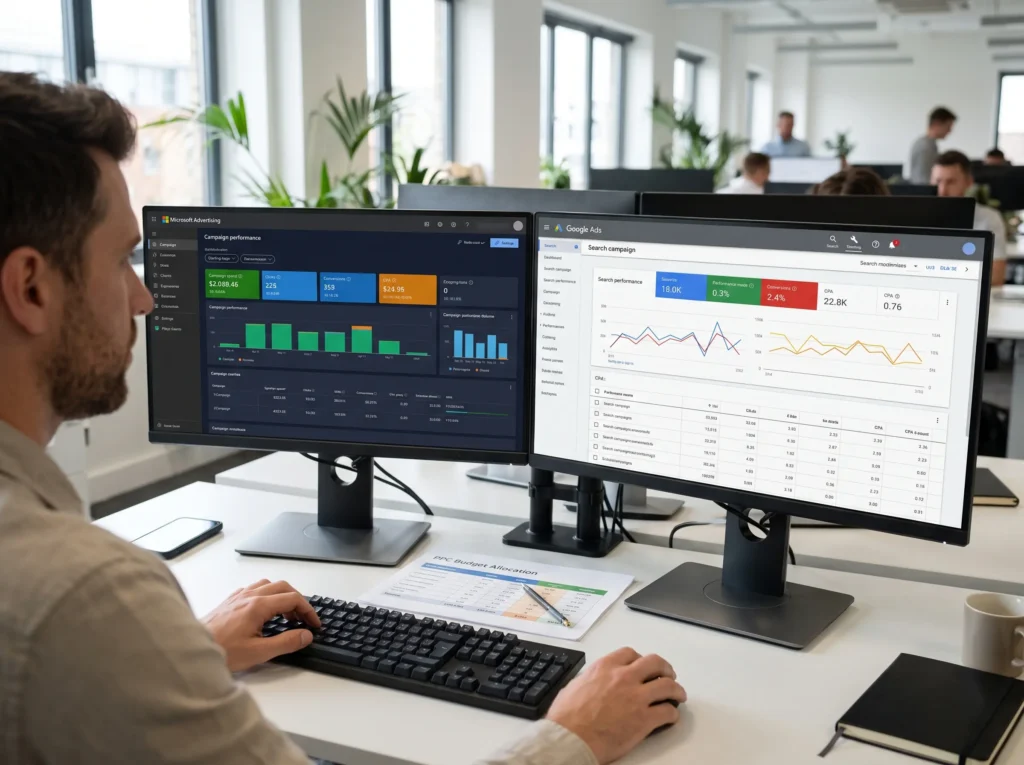
Most businesses treat Paid Search Advertising as a single decision – set up Google Ads and spend there. Google’s dominance makes that feel obvious. But a competent PPC Advertising Agency rarely stops at Google, because the real question is never about “which platform is bigger” but “where does each dollar work hardest for this specific business?”
Statcounter reported August 2026 search shares of 89.94% for Google, 5.29% for Bing, 1.3% for Yahoo, and 0.74% for DuckDuckGo worldwide. A PPC Advertising Agency allocates budgets on the basis of conversion quality, acquisition costs, available search demand, business goals, etc., not platform popularity alone.
As per MB Adv analysis of 73 advertisers, average CPCs were $1.54 on Microsoft versus $2.93 on Google during October 25–26.
In this blog, we’ll compare Microsoft Advertising and Google Ads on the numbers that affect budget decisions. Keep reading!
Key Insights
- According to searchlab.nl, the Microsoft Search network is estimated to reach 700 million or more users monthly by 2026.
- B2B and lead generation help with LinkedIn profile targeting across companies, industries, and job functions, something Google Ads cannot match directly.
- According to Kseniia Shermin, Microsoft Ads CPCs are 25–40% lower than Google’s, while cost per conversion averages 31% less across most industries.
- The gap between Microsoft Ads and Google Ads tends to be widest in expensive verticals such as legal, finance, and B2B software, where Google CPCs can be very high.
- According to Microsoft.com, Microsoft Copilot generates 73% higher click-through rates and a 16% better conversion rate than traditional ads.
Microsoft Ads vs. Google Ads – What’s the Difference?
Google Ads and Microsoft Advertising both let businesses reach potential customers through Paid Search Advertising, but their reach, audience opportunities, competition, and campaign performance can differ.
Businesses evaluating Online Advertising Services compare platform reach, audience targeting, campaign costs, and conversion potential before deciding where to invest.
Google Ads is generally the first choice when you need search reach. Microsoft Advertising supports that with its additional search network and offers additional audience-targeting options.
The Market Share Picture is More Nuanced Than It Looks
- US Market Presence: Bing holds a stronger search position in the US than its global market share suggests.
- Desktop Advantage: Bing’s US desktop search share reaches the mid-teens, with Bing and Yahoo combined capturing a larger share.
- Access to Untapped Audiences: Millions of US searchers reportedly use alternatives to Google, creating additional opportunities for advertisers.
- Smarter Budget Allocation: For businesses that focus on the US market or have a predominantly desktop presence or a B2B model, evaluating qualified traffic, conversions, and cost of acquisition makes more sense than global market share.
Where Each Platform Tends to Win
Google Ads Tends To Win On:
- Sheer volume and reach, especially on mobile.
- Younger and broader consumer audiences.
- Categories where you need maximum possible scale.
- Access to YouTube, Gmail and the Display Network alongside search.
Microsoft Advertising Tends To Win On:
- Older, higher-income and desktop-heavy audiences.
- Expensive verticals where the CPC gap is largest, such as legal, finance and SaaS.
- Budget-constrained advertisers who want more clicks for the same spend.
- Reaching the segment of searchers who simply do not use Google.
The LinkedIn targeting point is genuinely distinctive – because Microsoft owns LinkedIn, it targets ads by professional attributes in a way no other search platform offers. That is why B2B campaigns often perform disproportionately well there.
Match The Budget to the Business Model
Different businesses favor one platform over another for different reasons. Paid Search Advertising helps businesses capture demand from users actively searching for relevant products and services.
1] B2B and Enterprise Services
- Microsoft Ads needs a structured approach if you’re targeting by company, industry, and function.
- Google remains valuable for capturing explicit searches for services and solutions.
- According to a Gartner survey, buying groups that reach consensus are 2.5 times more likely to report a high-quality deal.
2] Ecommerce
- Identify the platform customers use to search for products and compare profitability and conversion on a product-level basis.
- Don’t assume cheaper clicks will produce cheaper sales.
- According to DHL e-commerce, 95% of global shoppers say delivery options influence shopping decisions, underscoring the need to measure purchases and profitability, not just clicks.
3] Local Businesses
- Prioritize the platform that reaches customers searching within your service area.
- Test a second platform if demand is sufficient and the economics support it.
- According to BrightLocal, 84% of customers searched online for local businesses in the past 3 months, as per 2026 research.
4] High-consideration Purchases
- The customer might see the ad, research the item, return later, buy through a different channel, etc.
- Reporting needs to be consistent, and experiments used, where possible, to evaluate incremental effectiveness.
- According to eMarketer, nearly 90% of consumers across the US, UK, France, and Germany reportedly cross-check search results across multiple platforms.
How a PPC Advertising Agency Should Allocate Budget
PPC Agency determines the acquisition cost, conversion quality, and demand generation before rebalancing budgets. There is no right way to allocate the budget, but there is a right way to think about it.
- Start Google-First For Most Consumer Businesses: When you have a broad audience that is young and mobile, the pervasiveness of Google makes it the natural focal point of the account, while Microsoft becomes its complement.
- Run Both From The Start for B2B and High-Value Verticals: If you sell to professionals, target an older or higher-income buyer, or operate in a vertical where Google CPCs are very high, Microsoft deserves budget from day one rather than as an afterthought.
- Let Google Impression Share Inform the Shift: When Google campaigns are already capturing most of the available impressions for your best keywords, extra budget there buys diminishing returns.
- Decide With Your Own Data, Not Benchmarks: Published numbers on CPC and conversions are just a hypothesis to begin with. It is your own cost per acquisition and, hopefully, the profitability on each channel that will determine your budget allocation.
- Account for the Management Overhead. Running two platforms means two sets of campaigns, tracking, and reporting. The efficiency gains usually justify it, but a good agency will be honest – the second platform is only worth adding if it is managed properly, not left on autopilot. Microsoft Advertising lets you import campaigns directly from Google Ads, which lowers the cost of testing it.
Common Budget Allocation Mistakes to Avoid
Even seasoned advertisers overspend because they focus on platform statistics rather than business results. Reliable online advertising services can pinpoint waste, gauge conversion performance, and help adjust the budget through proper tracking and reporting. Here are some common mistakes to avoid:
- Assuming Microsoft is Always Cheaper: CPC depends on keyword, target audience, and level of competition.
- Giving Google the Entire Budget: This may overlook valuable incremental demand.
- Splitting Budgets Equally: Equal budget distribution doesn’t ensure equal results.
- Copying Campaigns Without Review: Targeting, bidding, tracking, and other settings must be updated.
- Changing Budgets Too Frequently: Frequent budget changes will complicate performance analysis.
- Ignoring Lead Quality and Attribution: The cheapest lead won’t necessarily become a customer, while multiple platforms could claim attribution.
Review allocations regularly based on conversion quality, acquisition costs, search demand, and business goals.
Why Choose UNV Digital – Best PPC Advertising Agency
The Microsoft Ads versus Google Ads question is rare. Google brings unmatched reach; Microsoft brings cheaper clicks, a distinct and often more affluent audience, and LinkedIn-powered B2B targeting.
UNV Digital is a top-rated PPC Advertising Agency that provides PPC Advertising Services to set clear targets, protect proven campaigns, test new opportunities, and shift budgets based on qualified conversions and profitability.
With 10+ years of experience, our team understands audience intent, tracks conversions accurately, evaluates lead and customer quality, and allocates budget based on evidence. We offer Online Advertising Services that deliver results.
Your budget deserves better than a blind click. Google, Microsoft, or both? Let’s find the winning mix for your business. Contact us to turn smarter PPC decisions into qualified leads, stronger conversions, and measurable growth!
Frequently Asked Questions (FAQs)
1] Is Google Ads Better than Microsoft Ads?
Neither platform is universally better. Google Ads provides broader search reach, while Microsoft Advertising provides access to distinct audiences, competitive click costs, and LinkedIn-powered B2B targeting. UNV Digital is the Best PPC Agency that evaluates audience intent, conversion quality, campaign profitability, etc., to identify the right platform mix for each business.
2] What Percentage of My PPC Budget Should Go to Microsoft Ads?
The ideal allocation depends on campaign goals, search demand, performance, etc. UNV Digital begins with a controlled test and adjusts the budget based on qualified leads, acquisition costs, available search volume, and incremental conversions. It helps businesses invest where their advertising budget delivers meaningful results.
3] Is Microsoft Advertising Cheaper Than Google Ads?
Microsoft Advertising can offer lower cost-per-click rates in some industries, but costs vary by keyword, location, audience, and competition. UNV Digital is the leading PPC Agency that looks beyond cheaper clicks to evaluate qualified conversions, cost per acquisition, and customer value, helping businesses invest in the platform that delivers stronger commercial results.
