

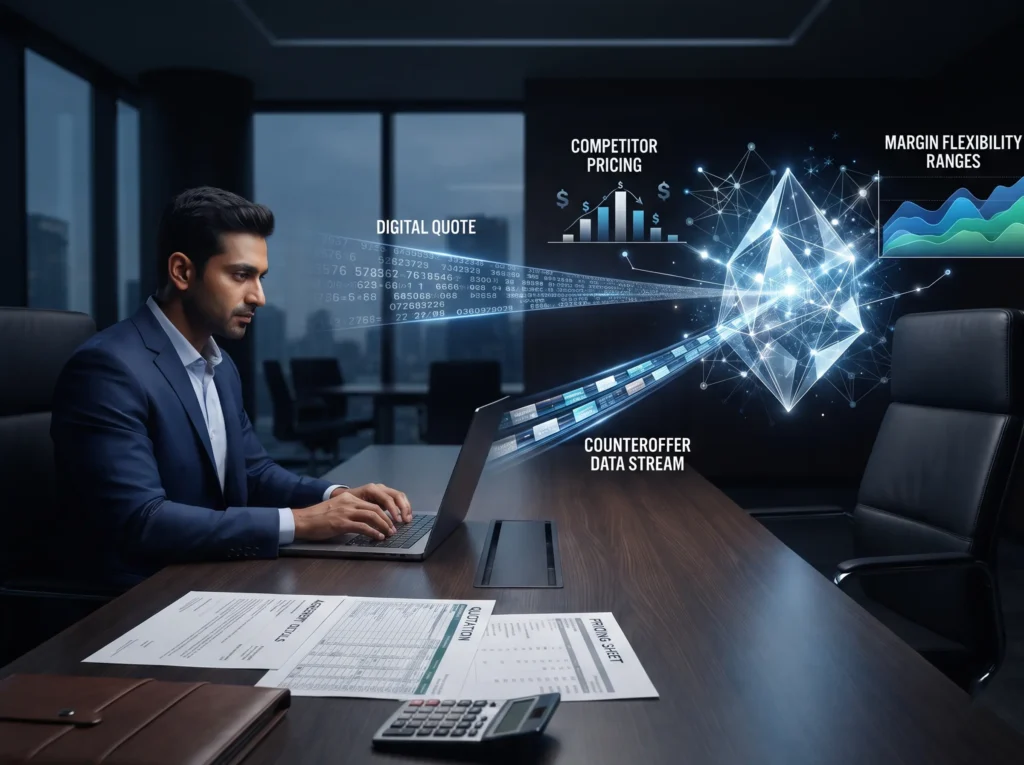
A buyer’s procurement team is no longer negotiating alone. Increasingly, they hand negotiations to an AI agent that compares competitor pricing, model margin flexibility, and generates a counteroffer before a human reads the email.
AI in B2B Marketing is transforming traditional sales negotiations. According to Forrester.com, at least 1 in 5 B2B sellers are compelled to respond to AI-powered buyer agents with dynamically delivered counteroffers, where sellers control agents in 2026.
AI Negotiation Agents are bringing a structural shift in how deals get negotiated in B2B marketing. As per authoritytech.io, 94% of buyers use AI in their purchasing process, and 88% of B2B organizations are deploying and actively planning to deploy AI agents of their own.
In this blog, we will explain why AI Negotiation Agents matter and how Intelligent Sales Automation is reshaping B2B deal-making. Keep reading!
Key Insights
- According to a Gartner survey, 67% of buyers prefer a sales representative-free experience, while 70% prefer a completely digital commerce self-service buying experience.
- Indian B2B sales still run heavily through distributors, tenders, and relationship-led selling, all of which need rethinking for AI in B2B marketing and sales.
- According to learn.g2.com, 51% of buyers research with an AI chatbot more often than Google, and 71% rely on an AI chatbot in the software research process.
- B2B procurement agents will autonomously negotiate prices, contracts, and service levels across multiple suppliers simultaneously. Adaptive agent-to-agent negotiation will replace static pricing and manual quote handling by default.
- According to Salesforce.com, sellers who partner with AI sales tools are 3.7 times more likely to meet their deal-closing quota.
What Forrester’s B2B Prediction Means
AI negotiation Agents are being used across the B2B industry. It is not a chatbot assisting with quoting but a structurally different process: a buyer-side procurement agent.
AI Negotiation Agent operates under defined parameters, such as a budget ceiling, required terms, and an acceptable service level. It mostly generates and sends a counteroffer to the seller.
The Trust Gap – Why This Prediction Comes With a Warning
- According to Forrester’s report, 19% of buyers using generative AI purchasing tools already feel less confident in their decisions, citing inaccurate information provided by AI.
- Without proper governance, AI adoption in B2B marketing can expose organizations to financial, legal, operational, and compliance risks that will directly impact business performance.
- Hence, human expertise isn’t disappearing from B2B sales; its role is shifting earlier and later in the funnel. AI validates and builds trust by handling the mechanical middle-of-the-price and term negotiations.
How AI Negotiation Agents Work

An AI Negotiation Agent doesn’t work like a chatbot that says, “Can I get the discount?” It is a structured system that researches, scores, and bargains on the buyer’s behalf. Negotiation often happens without humans touching the exchange until final sign-off.
The Anatomy of an AI Negotiation Agent
On the procurement side, these agents typically:
- Pull Historical Data: The AI agent pulls historical data from Past Representative-free procurement, contracts, discount patterns, and pricing benchmarks.
- Layer in Market Signals: The AI agent layers in market signals, such as material costs, inflation indicators, and competitor pricing where available.
- Generate a Negotiation Strategy: It includes target range, fallback positions, and talking points.
- Execute the Back-and-Forth: AI Negotiation Agent sends counteroffers, evaluates seller responses, and escalates only when it hits a defined limit.
It mirrors how procurement-focused AI negotiation platforms already operate in the market, evaluating supplier bid prices. AI Negotiation Agent works against historical proposals, contracts, past discounts, and macroeconomic indicators like material costs and inflation, then generating a negotiation strategy.
What Makes an AI Negotiation Agent “Good”
AI-to-AI negotiations found something counterintuitive: the best-performing agents did not win because they were more aggressive.
AI Negotiation Agents won because they prepared better, completing a rigorous pre-negotiation analysis before sending a single message.
Why AI Negotiation Agents Hit Indian B2B Sellers Differently
1] Distributor-Led, Tender-Heavy Go-to-Market
- A large portion of India’s B2B pipeline flows through a multi-tier distributed network and complex tender PDFs rather than direct sales.
- Generic US-built CRM automation often misses these channels unless engineered to meet tender requirements and support localized pricing infrastructure.
2] AI Adoption is Already Moving Past Early Adopters
- AI integration in Indian commerce is moving rapidly beyond tech enterprises.
- According to the Snapdeal Bharat Seller Report. 56% of the surveyed sellers, including MSMEs and traditional vendors, are actively using AI tools to optimize business operations.
- According to the Salesforce report, 81% to 87% of the sales team use an AI sales assistant in some capacity.
- According to autobound.ai, signal-specific personalization achieves an 18% response rate, more than 5x the generic average, through AI and through an AI Sales Assistant.
3] The Relationship-Selling Question
- Human rapport with procurement AI no longer serves as the entire sales strategy.
- Instead, personal relationship now forms the secondary trust layer that closes the deal after an AI negotiation agent has evaluated and shortlisted the initial quote. It is based on brand visibility and digital credibility.
How to Prepare: A Readiness Framework
Step 1: Build Pricing Logic First
- Transition pricing from informal tribal knowledge into a defined algorithm.
- Document floor pricing, discount bands, and tier-based approval thresholds while factoring in localized variables like GST implications, distributor churn, and regional payment terms.
- If a rule is too vague for human interpretation, an AI agent cannot negotiate from it.
Step 2: Deploy a Seller-Controlled Counter-Agent
- Implement a seller-side AI agent with an existing CRM and quoting system to evaluate buyer-board terms in real time.
- For an Indian seller, this doesn’t mean building custom AI from scratch. It means integrating Intelligent Sales Automation into the existing CRM and quoting workflow.
- Thus, human-only steps in manual negotiation if the conversation crosses the final threshold.
Step 3: Centralize and Digitize the Data Foundation
- An AI Sales Assistant is only as good as the data behind it. Integration of fragmented deal history, experts, and communication channels into one integrated search engine.
- Digitize legacy bid PDFs and RFP answers, tagging previous negotiation successes for agent training.
Step 4: Strengthen Discoverability Layer
- Optimizing external digital assets allows the buyer-side research agent to surface the brand during the discovery process.
- AI in B2B Marketing can enhance outreach by understanding case studies, verifiable client outcomes, structured product data, and marketing negotiation channels.
Why Choose UNV Digital – Preparing Indian B2B Sellers for the AI Negotiation Era

For an Indian B2B organization, the starting point is not building a fully autonomous AI Negotiation Agent. It’s about building qualification, data hygiene, and governance infrastructure.
At UNV Digital, we help Indian B2B companies build the foundation to shift demands from AI-ready content and structured data that helps shortlist marketing systems. We focus on creating Intelligent Sales Automation that supports intelligent and data-driven sales.
Our team of experts focuses on how strong digital visibility and credible, verifiable positioning translate directly into pipeline. AI buyer agents now scan these signals before a human ever picks up the phone.
The future of B2B selling is AI-powered, and the right strategy gives your business a competitive edge. Contact us today to build an AI Negotiation Agent, and let’s get your business ready before agent-led negotiation becomes the default, not the exception!
FAQs
-
What exactly is an AI Negotiation Agent?
An AI negotiation agent is a software system that researches pricing, market data, and past deal history, then negotiates terms like price, payment schedule, and delivery on behalf of the buyer or seller. It often runs with minimal human involvement until the final decision point.
-
Do I need to buy an AI Negotiation Agent right now?
Not necessarily immediately, but you do need pricing logic, clean deal data, and a plan. Sellers who wait until a buyer has already negotiated against them start with a data and speed disadvantage and are hard to close mid-day.
-
How long does it take to become AI-negotiation-ready?
A foundational readiness sprint (documentation of pricing logic, data clean-up, and audit of discoverability) normally takes four to six weeks. But implementing counter agents depends on the current CRM/sales stack, and most mid-sized Indian B2B companies can set up their system within one to two quarters.
