

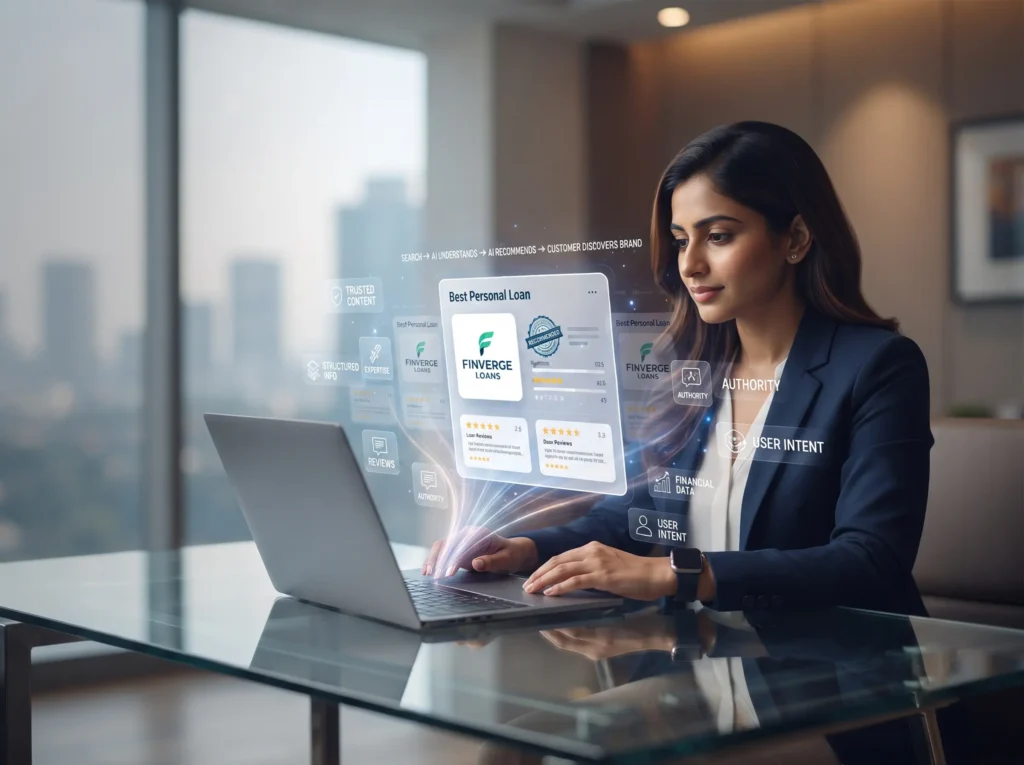
The Google search journey for personal loans has changed dramatically in 2026. Searches for “best personal loan” now often trigger AI overviews and citations. According to adlift.com, 44% of Your Money or Your Life searches already trigger AI overviews.
When someone searches for “Best Personal Loan,” they see AI citations. AI-powered search assistants now answer user questions by pulling information from trusted sources. As a result, it is becoming harder for banks, NBFCs, and fintechs to gain visibility through SEO alone.
NBFCs and Fintechs have seen organic clicks shrink, but the brands cited in AI answers are capturing trust and leads. According to ahrefs.com, 38% of pages cited in AI overviews rank in the top 10 on Google.
In this blog, we will explain why lending queries are increasingly cited by AI and share practical Fintech SEO strategies to improve brands’ AI visibility. Keep reading!
Key Insights
- According to ganitinc.com, AI-powered personalized engagement has increased conversion rates by 45% and reduced marketing costs by 30%.
- E-E-A-T signals carry extra weight for YMYL (Your Money or Your Life) queries, such as “best personal loan”.
- According to authoritytech.io, 82% to 95% of AI citations for financial queries go to earned media and established outlets rather than brand-owned content.
- For YMYL financial content, credibility is the primary gating factor for citations, not keyword density, not backlink count, not even traditional ranking position.
- As per Technavio.com, the AI in the Fintech market size is valued at USD 35.61 billion, with a CAGR of 22.7% from 2025 to 2030.
The AI Overview Revolution in Personal Finance Search

Financial and education queries are the domain where AI overviews are expanding significantly. For informational finance queries, coverage rates are already approaching saturation. Best Personal Loan, Bank Loans Online, and Personal Loan Interest Rate all fall into one bucket.
What Google’s AI Overview Actually Rewards
Google tends to evaluate whether the content is safe, specific, and well-attributed enough to summarize confidently for the query like “best personal loan”. Here are the prominent signals:
1] Structured and Extractable Answers
Content should be written in clear question-and-answer blocks, short, definitional sentences, and a comparison table. AI systems can understand and cite this more easily than long narrative paragraphs.
2] Author and Institutional Credibility
A byline paired with an RBI-registered NBFC acts as a trust marker. It materially states how confidently Google can surface particular content.
3] FAQ and Schema Markup
FAQ Page structured data remains one of the most reliable ways to make content AI Overview-eligible, since it provides the algorithm with a question-answer pair.
Why Clarity Beats Comprehensiveness
According to kpmg.com, 28% of organizations are selectively using AI in financial reporting, and that number is expected to jump to 83% over the next few years.
Short-form content with strong and clean formatting gets cited more often. AI systems extract discrete, well-structured facts to build an answer; content optimized for extraction.
For “Best Personal Loan,” content specifically means:
- Write the specific answer directly, including the interest rate range, eligibility criteria, and processing time rather than a lengthy guide.
- Structure comparison content, which is your rate vs. category benchmarks, in a directly scannable table rather than in a paragraph.
- Answer the inquiry for the query – best personal loan for salaried employees. The eligibility specifics for salaried applicants front and center. No generic loan information should be there.
GEO and AEO Tactics That Get You Cited
Generative Engine Optimization (GEO) and Answer Engine Optimization (AEO) are not replacements for traditional fintech SEO; they’re the layer on top.
The lenders being cited in AI Overviews publish genuinely authoritative, well-structured, verifiable content. Whether users are comparing the best personal loan or searching for bank loans online, the AI system prioritizes content that is structured, trustworthy, and easy to verify.
Here’s what that looks like in practice.
Write for Extraction, Not Just Ranking
AI tends to cite content that is easy to extract and summarize. It is done as follows:
- Lead Every Section with a Direct Answer: Don’t bury the answer three paragraphs in. State it upfront, then elaborate.
- Use Concrete, Specific Language: Never use vague terms like “competitive interest rates” in your copywriting; rather, use the phrase “interest rates starting from 9.99% p.a. for eligible customers. AI gives preference to verifiable statistics.
- Frame Content as Q&A Pairs: Even if the page is not an FAQ, structure the content in subsections as a question followed by a direct answer. Create passage-ready content that Google AI can cite directly.
- Cite Sources Inline: While creating content, make sure to cite official sources such as RBI, CIBIL, and IMARC guidelines. AI models that evaluate financial authenticity always look for attribution that states accurate claims.
Technical SEO and Schema for Fintech Visibility
The technical SEO layer for NBFCs and Fintechs in 2026 is more specific than it’s ever been. General on-page optimization is table stakes. What moves the needle for AI Overview eligibility is precise schema implementation.
SEO best practices for banks help financial institutions improve AI visibility for high-intent lending queries.
Financial Product and FAQ Schema
For the Best Personal Loan product pages, implement these schema types in priority order:
- Financial Product Schema: Always mention loan name, type, APR range, minimum or maximum loan amount, repayment tenure, and fee details. It is the signal that indicates product-specific information to the AI system.
- FAQ Page Schema: Gives ready-made Q&A pairs that can appear directly in AI-generated results. This is the single most effective schema type for AI Overview eligibility in the BFSI category.
- How To Schema: Use for process-driven content like “How to apply for a personal loan online” with clear, numbered steps.
- Breadcrumb List Schema: Improve crawlability and entity clarity for AI models to map site structure.
Freshness Signals That Matter
- According to takeagander.ai, web page content less than three months old is 3x more likely to get cited; pages that are not updated quarterly are 3x more likely to lose citations. This is especially true when interest rates, RBI regulations, and eligibility criteria change frequently.
- Therefore, accuracy is necessary. Use visible session indicators like “last updated on August 2026” to indicate the current interest rates at NBFCs.
- It is a lightweight operation with minimal impact on citation retention.
Building a Fintech SEO and SEO for Banks Roadmap

Step 1: Audit Entity Consistency
Make sure the name, registration number, and basic facts of the NBFC or Fintech are consistent across the website. Rectify any inconsistencies before proceeding to create content.
Step 2: Assign Named, Credentialed Authors
Build explained author pages for every content contributor on loan-related pages, with verified credentials and an editorial review process.
Step 3: Deploy Lending-Specific Structured Data
Implement FinancialProduct, LoanOrCredit, Organization (with sameAs), and FAQPage schema across every personal loan product and comparison page.
Step 4: Rewrite for Extraction, Not Just Ranking
Break down comprehensive guides into easy-to-scan, clearly answered questions that emphasize formatting and authenticity.
Step 5: Establish a Quarterly Refresh Cadence
Create an internal process to review and refresh every rate- and eligibility-dependent page quarterly. Especially when RBI policy changes frequently.
Step 6: Track Citation, Not Just Rank
Set up manual and tool-assisted tracking of actual presence inside AI-generated answers for priority queries, not just traditional keyword position.
Why Choose UNV Digital – Your Fintech SEO & AI Search Partner
The best personal loan keyword category is one of the most competitive SEO battlegrounds in India. Winning it in the age of AI overuse needs a specific combination of capabilities.
At UNV Digital, we bring 10+ years of digital marketing experience and a strategy built specifically for Banks, GEO, content, and financial-sector nuance.
Our team has a sharp understanding of how YMYL trust signals translate to AI overviews, eligibility, and ultimately to qualified leads. We don’t just build content that ranks.
We build content architecture that earns citations in AI answers, drives brand search volume, and converts traffic into consultation requests and online loan applications.
Our strategies help banks, NBFCs, and Fintechs improve visibility for Bank Loans Online through AI-first SEO.
Whether you are an NBFC looking to break into AI search visibility or a fintech wanting to scale with SEO services for loan products. Contact us today and let us map your path to AI overview dominance!
FAQs
-
What is an AI Overview and why does it matter for personal loan queries?
Best personal loan queries: An AI overview is a Google AI-generated summary that appears above the organic result for certain queries. For personal loan searches, it gives answers based on various data sources. Even without a click-through, brands can gain exposure for their websites.
-
How is Fintech SEO different from regular SEO?
In Fintech SEO, Google’s YMYL guidelines apply, so financial content must meet higher standards. Signals such as E-E-A-T, authors’ qualifications, citations of regulations, and source attribution matter more than they do for other types of content. It also helps financial institutions improve visibility for users searching for Bank Loans Online through AI-powered search.
-
Can a smaller NBFC with a lower domain authority compete in AI Overviews?
Yes, it is one of the most significant opportunities in fintech SEO for 2026. AI Overviews prioritize strong compliance signals (RBI registration, adherence to digital lending guidelines), banking partnership mentions, and high structure and verifiability of content. In AI search, authority is based on trust, not backlinks.
