

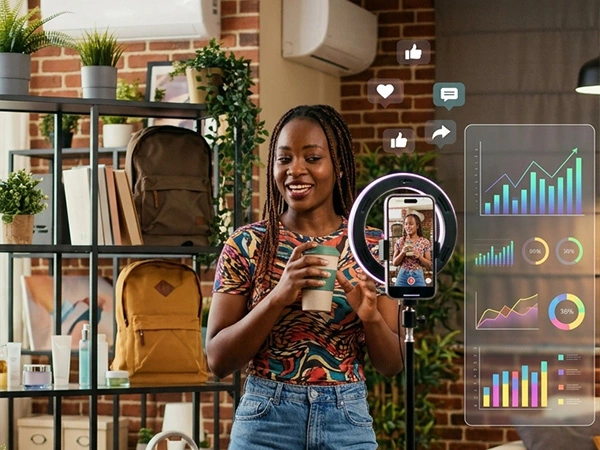
The waves of creator-based marketing have been rippling through brand development. Many businesses spend lakhs on traditional advertising, but the nuances of minimal results affect their annual results. With the creator economy advertising channels of marketing are getting the upper edge.
The global creator economy advertising market is expected to grow to around USD 1,072.8 billion by 2034, as per the reports of market.us. TikTok marketing strategy is capturing the lion’s share of unprecedented growth. It is nurturing the real business growth.
Partnerships with influencers stimulate the brand growth through TikTok creators. According to ion.co, TikTok creators boost the ad recall by 27% and engagement by 83%. These collaborations also see a 91% surge in six-second views. It is as compared to traditional and non-creator advertisements.
In this blog, we will tell you about creator economy advertising and how influencer marketing trends are driving measurable results. Keep reading!
Key Insights
- According to IAB’s 2025 report, US Creator Economy Advertising reached $37 billion, up 26% year-over-year. Nearly 4x faster than the media industry’s overall growth.
- Brand growth through TikTok creators outperforms one-off campaigns by focusing on retention and frequency.
- As per the reports of AutoFaceless, creator based advertising delivers 3.70% engagement rates that crush every competing platform.
- E-commerce brands through TikTok create intent rather than capturing existing demand.
- Strategic influencer marketing trends combine micro- and macro-creators. It creates full-funnel performance engines.
What is Creator Economy Advertising

Creator Economy Advertising is the sophisticated performance marketing where brands build structured partnerships with content creators. It is necessary to enhance audience reach, engagement, and conversion on a large scale.
The Interactive Advertising Bureau 2025 Creator Economy Ad Spend & Strategy Report states that the US creator economy ad spend reached $37 billion in 2025.
What Makes Creator Economy Advertising Different from Traditional Influencer Marketing?
1] Professionalism of Creators
According to insights.ttsvibes.com, Top TikTok creators earn $400 to $1000 per million views. It marks a 10-25x increase over the discontinued Creator Fund.
Influencer marketing trends are consistently evolving and generate revenue for professional creators. The optimally funded creators produce high-quality content and develop valuable engagement.
2] Performance-based measurement
Currently, brands measure their relationships with creators by measuring cost per acquisition, return on advertising spend, and lifetime customer value. It is not based on static impressions and engagement.
3] Platform Integration
Native commerce tools have significantly transformed creators from awareness drivers to revenue creators.
As per the reports of eMarketer, 59% creator revenue now comes from sponsored content. With platform payout and affiliate marketing making up the balance.
Why TikTok Dominates the Creator Economy Ecosystem
TikTok has transformed from merely a social media platform into a brand growth accelerator. It is among the best performance marketing platforms for promoting creator-led campaigns.
Authenticity Over Production Value
According to Emplicit, 92% of consumers trust influencer recommendations over brand messaging. It led to 29% boost in conversion rates.
User-generated content (UGC) has significant advantage over cold messaging through Instagram, Facebook, or WhatsApp.
Algorithm Driven Discovery
TikTok doesn’t reward creators with large followers. But it rewards content quality, watch time, and engagement. As per the insight of Gembah, a creator with 15,000 highly engaged followers can outperform someone with 150,000 passive followers.
It all depends on consistent posting, regular engagement, and quality content.
Trust Transfer
TikTok market strategy is helping brands in the right direction. When a creator recommends a product, Gen Z users tend to research it further.
According to riseatseven.com, 72% of all users say they discover new products and brands on TikTok.
Speed to Market
A traditional ad campaign takes 6 to 8 weeks to bring results. It includes concept, production, approval, and launch. Creator partnerships take 5-7 days to deliver results. It includes briefing, content, approval, and publishing.
Niche Targeting
TikTok creators with a million followers mean they have access to a hyper-specific audience. If the brand wants to target Indian tech founders relocating to Dubai?
There are creators for that. When the brand wants to target sustainable-fashion buyers in Mumbai, there are multiple creators in that niche.
Understanding Creator Tiers and When to Use Each
Not all content creators offer the same level of value. The business must know when to collaborate with nano-, micro-, or macro-content creators. As their ROI and campaign effectiveness will depend on that decision.
Nano Influencer (1K to 10K)
Nano influencers are best for hyper-niche targeting and grassroots authenticity. It is ideal for testing which product gets deeply engaged with specific communities.
Micro Influencers (10K to 100K)
Micro influencers are driving brand growth through TikTok creator engines.
They tend to provide the highest ROI and higher engagement. It is because audiences trust their real person authenticity over polished ads.
Macro Influencers (100K to 1 Million or more)
Macro-influencers are essential to a TikTok Marketing Strategy focused on mass awareness, cultural relevance, and rapid scale. While ROI is lower, it drives massive visibility.
Hence, influencer marketing trends favor a hybrid approach. They use macros for broad reach and micros or nanos to drive measurable conversions and community trust.
Building a High-Performance TikTok Creator Strategy
Creating a profitable TikTok creator program requires more than sending products to popular accounts. Here is the step-by-step framework that drives results in 2026:
Step 1 – Define Goals and Budget Allocation
Everything starts with setting goals correctly. As Archive.com reports, by 2025, 11.9% of brands will allocate more than 40% of their marketing budgets to influencer marketing. This should not stop there.
Initially, it is important to work with 20-30 well-assigned creators rather than superficially with 200 mismatched ones.
Step 2 – Research and Audience Alignment
To identify the right creators, brands need to analyze competitors’ content. Then match the creator’s audience to the product’s demographics. Reviewing the engagement pattern is necessary; high view counts mean nothing if the comments are generic or purchased.
Moreover, they assess the content style and values. As it reduces the chances of forced partnership.
Step 3 – Build Partnerships, Not Transactions
Move beyond one-off transactions by measuring sales data, offering custom code, and providing early product access. It is crucial to turn creators into long-term brand advocates.
When the partnership is structured correctly, the brand growth becomes viable.
Step 4 – Create Content Flywheels Through Authenticity
Prescriptive scripts produce inauthentic content that audiences ignore.
However, successful brands provide product pillars. The content angles give creators direction while leaving room for authentic execution.
Today, creators are trusted because they know their audience better than any brand. Hence, creative execution is based on focus, clarity, authenticity, and versatility.
Step 5 – Measure What Actually Matters
According to precis.com, TikTok’s true ROI is 10.7X higher than last click attribution. With the use of platform pixels, unique promo codes, and post-purchase surveys to capture the full impact of creator content.
The vanity metrics, such as views, likes, and follower count, don’t pay the bills. Focusing on the metric that drives business results matters.
TikTok Creator Advertising Trends Reshaping 2026
- Live Commerce Explosion: Real-time shopping sessions and “mega-lives” are driving higher conversions than traditional ads. It is stimulated by urgency and authentic creator demonstrations.
- AI-Powered Optimization: Creator Economy Advertising now utilizes AI and GMV Max to automate creative testing and campaign bidding.
- TikTok as a Search Engine: To ensure Brand Growth Through TikTok Creators, content must use intent-based keywords. The shift aligns with influencer marketing trends, in which 57% of Gen Z use the platform for primary discovery, according to IQInfluence.
Why Partner with UNV Digital for TikTok Creator Campaigns

At UNV Digital, we have executed Creator Economy Advertising across various prominent brands. They tend to deliver higher ROAS and engagement rates.
Our team of experts doesn’t just assign the creator at random. But we analyze audience demographics, engagement patterns, and content performance.
We track creators’ campaigns or existing programs with clear attribution, ROI analysis, and regular report sharing, whether you are planning to launch your first creator campaign or scale the existing one.
UNV Digital brings deeper expertise, access to high-quality creators, and campaign optimization for business outcomes.
Want to achieve global success through creator-led advertising? Contact us today and let us build a creator strategy that delivers ROI, not just impressions!
FAQs
-
What is creator economy advertising, and how is it different from traditional influencer marketing?
Creator Economy Advertising is the customized, performance-driven approach to partner with content creators. While in traditional influencer marketing, we focus on posts and awareness metrics. In 2026, brands will build dedicated creator networks and integrate commerce tools directly with them.
-
How long does it take to see results from TikTok creator campaigns?
Initial results, that is, views, engagement, and traffic, appear within 24-48 hours of content going live. Conversion and sales primarily follow within the first week of direct response campaigns.
-
How do I measure the ROI of creator partnerships?
Tracking of the creator campaign is like a performance channel. With the use of unique promo codes, UTM parameters, and pixels to attribute sales directly to creator content. Hence, TikTok delivers 10.7X more value than last-click attribution, according to precis.com.
