

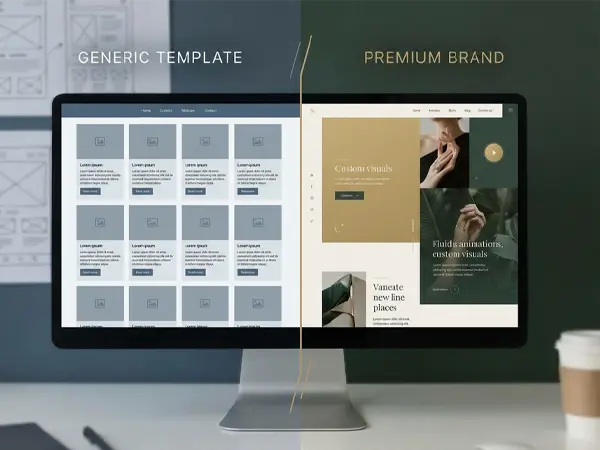
Business is growing, but the current website does not meet today’s digital standards. Due to this, many entrepreneurs get confused between a custom website vs template website.
In the natural world, the strongest and most adaptable one survives. But in the digital world, distinct, optimized, and experience-driven brand wins. According to G2.com, 94% visitors’ impressions depend upon the design of the website. The individual forms their opinion about a website within 50 milliseconds.
The website’s UX design is a prerequisite. It is not the digital brochure but an impression. A digital ecosystem relies on the fact that the first impression is the last. According to VWO reports, 66% of users abandon a website if it is not custom-built.
In this blog, we will provide an in-depth analysis of a custom website vs template website and why brands choose custom ones. Keep reading!
Key Insights
- Custom websites are built around the specific business goals, audience behavior, and conversion flow. But template websites are not.
- According to fyresite.com, a custom website for business growth brings 150% long-term ROI. It encompasses organic growth. A template website yields 60-80% ROI due to technical debt and eventual replatforming.
- Custom builds give businesses full control over technical SEO, security, scalability, and integrations.
- As per the reports of Big Commerce, a one-second delay in page load time can result in atleast 7% loss in conversions.
- The benefits of custom website development are beyond imagination; it mandates authentic brand positioning with a longer shelf life.
What is a Template Website and Where Does it Fall Short

A template website is a pre-designed layout. It can be WordPress themes, Wix themes, Squarespace themes, or Shopify themes.
In this, the website developer just plugs in the logo, colors, copy, and images, then goes live.
According to BeBusinessed, website templates save businesses an average of 50-70% on design costs.
Benefits of a Template Website
- Fast Deployment: The template website will take 2-4 weeks from start to launch.
- Lower Upfront Cost: The average cost of website development ranges from $3,000 to $150,000+, depending on the specifications, according to GoodFirms.
- Pre-built Functionality: E-commerce, forms, galleries, ready to use
- Regular Updates: Platform providers typically release security patches to ensure smooth operation.
- Large Ecosystem: There are thousands of plugins attached to a theme-based website.
Disadvantages of Template websites
- In-house Features: Template websites are equipped with unused features that increase load times and, consequently, lead to scalability issues.
- Add-ons Become Difficult: Adding features like membership systems, custom integration, and AI Chatbots is difficult on the template websites.
- Monotonous Features: The template website highlights the same things for everyone. Brands look copied instead of distinct due to template features.
- Security Vulnerabilities: Templates are often downloaded from an unverified source. It may lead to vulnerabilities, security leaks, and cyber threats. Thereby, it becomes a common point for hackers.
The Custom Website Advantage – Why Personalized Solutions Outperform Templates
When evaluating a custom website vs template website, the choice impacts the long-term ROI and brand authority.
Investing money in custom development ensures that the digital presence is a high-performance asset rather than a generic placeholder.
Brand Differentiation and Conversion
Custom-built websites eliminate the “cookie-cutter” look of shared themes. It focuses on every pixel with a unique identity. A custom website for business growth through optimized user journeys can boost conversions significantly.
Performance Driven Revenue
Custom website built with lean and purposeful code. It nurtures the website speed directly. According to Crystallize, a 0.1-second improvement in a mobile site can increase conversion by 8.4%. Performance gap is the primary reason why businesses need custom websites to remain competitive.
Scalability and Integrations
One of the major benefits of custom website development is future-proofing. Complex architectures tend to handle API integrations and market expansions that typically cause breaks in template websites.
Advanced Security and Compliance
Custom website development provides stringent protection for the website against cyberattacks. It ensures end-to-end encryption and authentication. A custom website for business growth in regulated industries requires security that a template website cannot provide.
SEO Structure Built for Ranking
The custom website focuses on organic dominance. It has Clean, semantic HTML, search engine optimization, strategic internal linking, optimized site speed, and mobile-first responsiveness.
Total Code Ownership and Control
With a template website, businesses are renting functionality. But a custom website provides complete ownership. From own code, own server, to own control. No vendor lock-in or platform dependency.
The Hidden Costs of Choosing the Wrong Option
User Experience (UX) is the most important factor in a website’s success. According to PwC, 59% of users will walk away after several bad experiences. However, 17% just after one bad experience. In addition, the horror story for business growth is disowned by clients.
As per PwC, 32% of all customers would stop doing business with a brand they liked after just one bad experience. For example, the business spent INR 20,000 on creating a template website, but after 1.5 years, the ceiling was hit, leading to technical debt.
The hidden costs of a custom website vs template website often emerge post-launch.
- Integration Struggles: The limited flexibility of the website forces expensive workarounds. The inclusion of custom support features can also demand revenue of $30,000 plus.
- Performance Drags: The bloated code on the template website can result in 4+ second load times. Hence, deteriorates SEO rankings and organic traffic.
- Security Risks: The reliability of the template website on third-party plugins creates vulnerabilities. It poses a major risk to customer data and brand reputation.
- Scalability Walls: Rebranding or upgrading a website often requires starting from scratch. Hence, making the benefits of custom website development clearer for long-term business growth.
According to Planet Green Solutions, a well-executed B2B site redesign improves conversion rate from 1.5% to 2.8% on 40,000 monthly visitors.
Hence, it becomes clear why businesses need custom websites from the outset to ensure long-term stability.
Custom Website for Business Growth – The Long Game
Businesses cannot achieve a longer shelf life with a template website. Popular brands like Zomato, Nykaa Fashion, and HDFC Bank invest in custom websites to improve reach and conversions.
- Market Value: According to Data Intelo, the custom website design market is valued at $14.8 billion in 2025, and expected to reach $38.6 billion in 2034. The shift from a custom website vs template website is now a multi-billion-dollar strategic move.
- Conversion Dominance: As per the reports of Data Intelo, customized services hold a 58.4% market share. It is mainly because sites generate conversion rates up to 2.8x higher than templates.
- Strategic Scalability: A key benefit of custom website development is the ability to integrate AI and headless CMS. Hence, businesses need custom websites to future-proof their operations.
- Geographical Momentum: The Asia Pacific region is leading the charge, with a 13.8% CAGR, according to Data Intelo. Thereby, proving that a custom website for business growth is the global standard for digital footprint.
Why Choose UNV Digital for Custom Website Development
At UNV Digital, we have been building custom digital experiences for over a decade. Our team of technical experts has delivered high-performance websites for prominent brands.
Every single custom website we build is designed to deliver higher conversion rates. We focus on the strategic positioning of the brand with custom websites.
The custom website vs template website debate is never about cost; it is about digital footprint with competitive differentiation.
Whether it is about creating a website for real estate, finance, B2B services, or other industries, our team knows how to support brand growth. We focus on conversion-focused design and create digital assets that drive optimal ROI.
Ready to build a custom website for business? Feel free to contact us today. We will help you map your ideal journey!
FAQs
What is the main difference between a custom website and a template website?
The difference between a custom website vs template website depends on UX, code, elements, graphics, fonts, etc. A template website uses a pre-designed layout for branding. A custom website is built for a business with customized architecture, UX flows, integrations, and SEO structure.
Are custom websites worth the higher cost?
Businesses serious about growth should choose custom websites. Custom websites deliver better SEO performance, faster load times, stronger security, and higher conversion rates.
How long does it take to build a custom website?
A professional custom website usually takes 6 to 16 weeks, depending on the scope. From discovery, design, to development, and content. The major question is, why businesses need custom websites? It is primarily for business growth, stimulating full transparency throughout.
