

Today, patience has been lost among the buyers. Whether it’s about buying groceries or gadgets. Everyone wants instant gratification. Quick Commerce in India is consistently evolving and pushing the boundaries for buyers.
According to Mordor Intelligence, India’s quick commerce market is valued at $3.65 billion in 2026. Experts project the market to reach $6.64 billion by 2031, growing at a 12.74% CAGR. Quick Commerce is proving that a hyperlocal and instant delivery system can grow in any Indian condition.
Q-commerce is primarily designed to bridge the gap of getting out of stock during peak times. According to IBEF, the Quick Commerce sector successfully generated 500,000 new jobs in 2025. It is significantly boosting blue-collar employment across the nation.
In this blog, we will elaborate on the quick commerce growth in India. We will also explain what quick-commerce trends in India are shaping the global economy. Keep reading!
Key Insights
- Market explosion: The revenue of Quick Commerce in India is expected to grow at an annual rate of 12.82%. Consequently, it results in a projected market volume of US$10.20bn by 2031. According to the reports of Statista
- Market Leaders: According to AKOI, India’s quick commerce market hit $6–7 billion in 2024, with Blinkit leading at over 50% market share by late 2025.
- Geographic Expansion: According to Mordor Intelligence, India’s quick-commerce market in Tier-I metro cities is valued at $3.65 billion in 2026. It is projected to reach $6.64 billion by 2031 with Tier II expansion.
- Category Expansion: Quick Commerce is growing beyond just groceries. Now it has opened doors to retail commerce, including smartphones, beauty products, and apparel.
Understanding Quick Commerce in India
Quick Commerce is the ultra-fast delivery of customer goods. Primarily, groceries, smartphones, beauty products, basic essentials, etc. It works within 10-30 minutes, according to ResearchGate reports.
How Quick Commerce Works
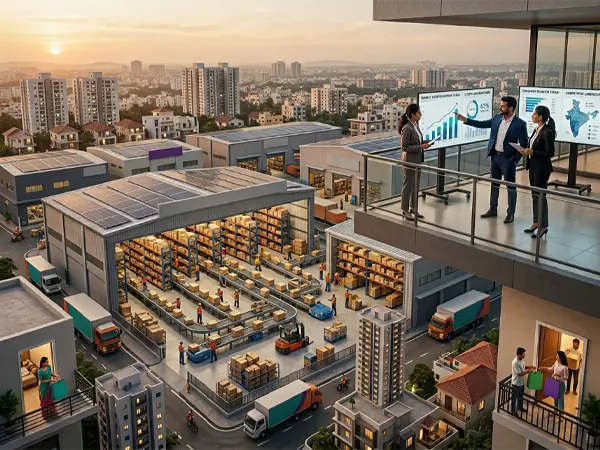
Quick Commerce Works in India through a hyperlocal micro-warehouse model.
- Hyperlocal Model: Quick Commerce market leaders in India operate through dark stores within a 1-3 Km radius to ensure instant delivery.
- Operational Efficiency: According to SW Cybernetics, dark stores serve a 2-3 km radius and carry 3,000-5,000 SKUs. It is expanded across personal care, grocery, and household categories.
- Infrastructure Growth: Quick Commerce market leaders like Blinkit, Instamart, and Zepto are planning to expand aggressively to meet rising demand.
- Emerging Trends: Quick commerce in India has shifted beyond groceries into high-margin categories. It includes electronics, beauty, and pharmacy to increase average order value.
Market Size and Growth Trajectory of Quick Commerce in India

Market Valuation
According to Mordor Intelligence, the market is valued at $3.65 billion in 2026. Research and Markets says that the market will achieve $12.97 billion in 2029 and reach $30 billion by FY 2030.
Leader Dominance
BofA Securities states that Blinkit holds the top position in the market with its 50% market share.
AKOI Research reports that Zepto experienced a 150% revenue increase, bringing its earnings to ₹11,110 crore in FY 2025.
Expansion Drivers
Tier 2 and Tier 3 penetration is fueling quick commerce growth in India. The electronics segment, which Mordor Intelligence expects to grow at a 17.78% CAGR.
Employment Impact
Kearney identifies the quick commerce sector as a powerhouse, generating 62–64 jobs per ₹1 crore GMV.
Hence, it is surpassing traditional e-commerce models.
Market Leaders: Blinkit, Zepto, and Swiggy Instamart
India’s Q-commerce market is one of the most consolidated in the world. Three platforms, Zepto, Blinkit, and Swiggy Instamart, hold 90% of the share. Here is how they are leading the quick commerce market:
- Blinkit: The dominant market leader. It is pulling ahead through an extensive dark-store network and expanding beyond groceries. They also include high-value electronics and premium goods.
- Zepto: A high-growth challenger focused on major metros. Zepto is maintaining its edge through rapid delivery speeds. They brought the entry of specialized sectors like pharmacy.
- Swiggy Instamart: According to an S&P Global report, quick commerce accounted for 14% of Swiggy’s fiscal 2025 sales. It is projected to rise to 20% in 2026 and reach 36% by 2031
- Emerging Market Leaders: Flipkart Minutes, BB Now (BigBasket), and Amazon Tez are growing significantly. Hence, competing with existing Quick Commerce market leaders in India.
Quick Commerce Trends in India
With the advent of the Quick Commerce trends in India. People’s buying tendencies are changing rapidly. Quick Commerce market leaders in India are focused on bringing a transition across major domains.
Dark Store Expansion and Optimization
According to SW Cybernetics, there are 5000+ dark stores across major cities. They serve across a 2-3 Km radius.
Regional SKUs customization is done for catering the specific needs of buyers instantly. It includes regional snacks, cuisines, and products.
They keep 3000-5000 SKUs as per the reports of SW Cybernetics.
Category Diversification Beyond Grocery
According to Bains & Company, 15% to 20% of Quick Commerce GMV now generates from non-grocery items.
Either it’s electronic gadgets like iPhone, mobile accessories, power banks, etc. Beauty care products such as sunscreen, lotion, and shampoo.
Myntra M-now tends to deliver fashion apparel, inner wear, etc. Ready-to-eat food materials are available through Zepto. Moreover, seasonal gifting items also become accessible with Quick Commerce in India.
Tier 2 and Tier 3 City Expansion
Metro cities like New Delhi, Jaipur, Bangalore, Mumbai, Coimbatore, etc., have seen Quick Commerce rise in India.
By the end of 2026, the Quick Commerce market is expected to expand across Tier 2 and Tier 3 cities.
Today, quick commerce companies are leveraging existing kirana partnerships (ONDC model).
Rather than building new dark stores, it will simultaneously help local owners and buyers.
Profitability Focus Over Growth-at-All-Costs
The platforms that experienced uncontrolled expansion through venture capital funding.
Now they have started focusing on building profitable business operations. It will help to generate sustainable profit margins.
Post-pandemic, businesses are not just looking for VC but a stringent path to profitability.
Technology and AI Integration
With AI-Integration, demand forecasting has become quite common. Machine learning helps to predict SKU need by store, day, and hour. It is based on the historical pattern and events.
For instance, Dark stores near colleges or schools keep higher SKUs during exam days.
AI manages product dynamic pricing during the peak hours. In addition, chatbots provide instant support for refunds or order changes.
Companies are evaluating voice ordering systems based on their ability to process voice search and order requests in local dialects.
Challenges and Opportunities
Profitability and Logistics
High operational costs and thin margins are the critical hurdles for Quick commerce in India.
However, the urban congestion and gig worker turnover further complicate 10-minute delivery.
Regulatory and Competitive Pressure
The evolution of labor laws and aggressive price wars from new entrants tends to challenge sustainability.
Quick commerce market leaders in India are under pressure from rivals like Flipkart minutes and Amazon Tez.
Strategic Expansion
Significant quick commerce trends in India show growth in untapped Tier ⅔ markets.
Moreover, inclusion in Quick Commerce boosted profitability in high-margin categories such as electronics and beauty.
Monetization
Platforms are opening doors for revenue through high-impact advertising and AI-driven demand forecasting. Hence, it is stimulating the momentum of Quick commerce in India.
Why Partner with UNV Digital for Quick Commerce Strategy

UNV Digital is helping brands to grow in the digital ecosystem. From maximizing visibility to building an omnichannel presence, we provide an end-to-end quick-commerce growth strategy.
Our team of experts analyzes the product category, profit margins, and target audience. Afterward, guide the businesses in choosing the right platform.
In addition, our prominent clients have achieved optimal growth in terms of revenue and visibility.
With AI-powered integration and performance marketing, our brands are able to make their value in a fast-evolving digital world.
Whether your business needs Q-commerce-specific strategies, hyperlocal SEO, or full-fledged digital performance marketing. UNV Digital helps in the right execution and revenue growth for businesses across the world.
Embark upon the growth in the retail channel with UNV Digital. Contact us for more details. Your growth will be our responsibility!
FAQs
How is quick commerce different from e-commerce?
Quick commerce focuses on delivering products such as groceries and other daily essentials within 10-30 minutes. It becomes possible with the availability of dark stores within a 1-3 km radius of residential areas. However, e-commerce delivers the product in 1 or 3 days, depending on the location.
Who are the top quick commerce players in India right now?
In 2026, there are three quick commerce market leaders in India. Majorly, Blinkit, Swiggy, Instamart, and Zepto. However, budding competitors are Flipkart Minutes and Amazon Tez.
Is quick commerce available only in metro cities?
No, quick commerce is not just available in metro cities. It is expanding beyond Tier 1 cities. The quick commerce growth in India across Tier 2 cities has brought significant change in the buying capacity of people. Cities like Jaipur, Ahmedabad, Pune, Surat, etc, are seeing accelerating Q-commerce adoption.
