

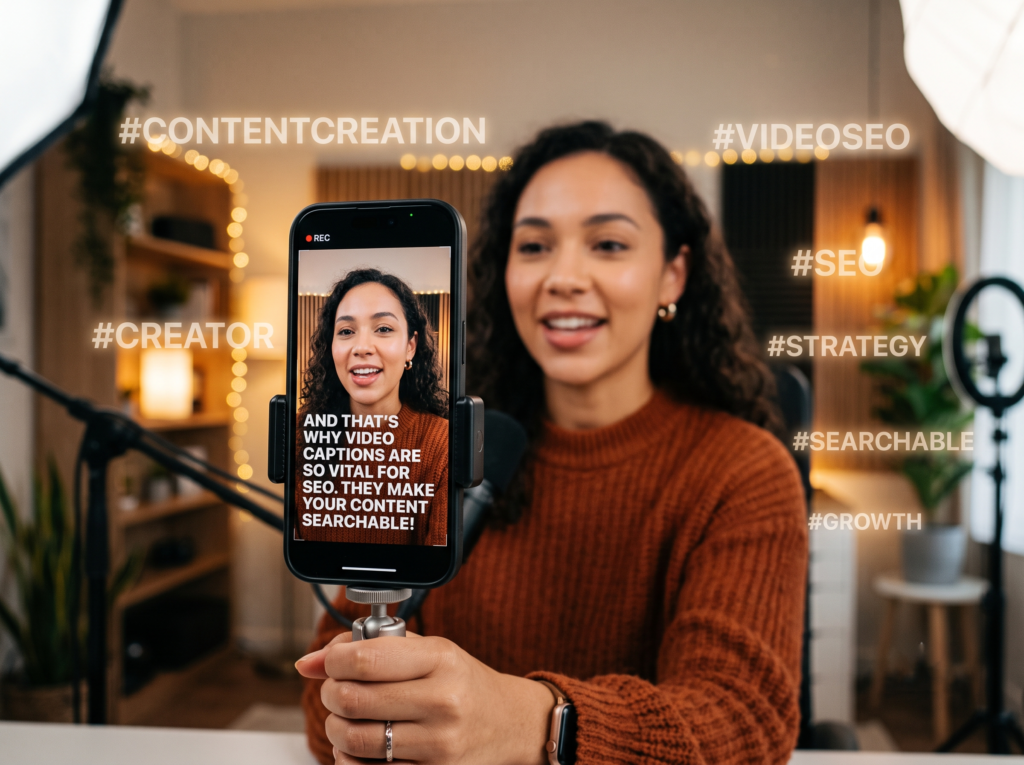
Search is not disappearing. SEO isn’t dying, but it is expanding beyond Google. Today, Instagram and Facebook have become the search engines; on-screen text, spoken words, and captions are more important than the long list of hashtags.
According to Design Rush, 81% of marketing experts believe that Social SEO has improved performance in the past six months. Social SEO helps content become more discoverable across both search engines and social platforms.
Reddit threads, TikTok clips, Instagram reels, and YouTube Shorts are becoming new sources from which an AI assistant cites summaries. As per the reports of adobe.com, nearly 1 in 2 customers use TikTok as their search engine, and 38% of business owners use TikTok influencers to boost product sales and promotions.
In this blog, we will explain why on-screen text and spoken keywords are outperforming hashtags and how to build SEO social media marketing for 2026. Keep reading!
Key Insights
- According to Thunderbit, although SEO Social Media Marketing channels are not a direct ranking factor for Google, they influence majorly through Reddit 37%, YouTube 19.8%, Quora 8%, LinkedIn 5%, and Instagram 2.6%.
- Instagram Limited has limited hashtags to 3 to 5 per post and removed hashtag following, cutting their reach functions to near zero.
- On-screen text, captions, and spoken audios are now primary discoverability channels or signals on Instagram and YouTube.
- According to Forbes data, 67% of the younger generation uses Instagram for search, 62% use TikTok, and 61% use Google.
- YouTube’s Gemini update reads on-screen text from a tone and editing room to build “semantic ID” of the content.
What is Social SEO, and Why is it not Optional Anymore?
Social SEO is optimization of captions, on-screen text, spoken audio, and profile information so that Instagram and YouTube surface the content in search results. It is not just about optimization of the algorithmic feed.
It borrows directly from traditional SEO principles, including keyword intent, content structure, and relevant signals. Instead of treating SEO vs Social Media Marketing as separate strategies, brands now combine both to maximize visibility wherever users search for information.
Why Hashtags Lost Their Power
Hashtags were never part of the search, but they are part of categorization. They tend to group content into tag-based feeds that users can browse or follow. The hashtag system made sense when platforms had limited ability to understand what was actually inside the video, image, or carousel.
That limitation no longer exists. Platforms now have:
- Speech-to-text transcription that reads every word spoken in a video.
- Optical character recognition that reads on-screen text overlays.
- Natural language processing that understands captions contextually, not just as a bag of keywords.
- Visual recognition that identifies objects, settings, and actions inside the content itself.
The Three Signals that Actually Drive Social SEO in 2026
Modern Social SEO operates on a clear hierarchy, and it mirrors traditional on-page SEO logic: say it, show it, write it in roughly that order of priority for video content.
1] Spoken Audio (Highest Weight on Video Platforms
- The transcriptions of spoken audio on Instagram Reels and YouTube are compared to what people search.
- Using the phrase “best CRM tools for small businesses” in the first few seconds of the video increases the volume of speech-to-text on Instagram Reels.
- Instagram Reels have 47% greater influence on an individual’s purchasing decision, as per Gadget 360.
2. On-Screen Text is New Meta Description
- The text within the screen served as a secondary searchable layer.
- It emphasizes the keyword spoken aloud, appeals to those watching without sound, and provides second confirmation for the algorithm’s OCR system of what the content is all about.
- Instagram posts with text overlays receive 40% more engagement according to Fanpage Karma insights.
3. Captions and Descriptions
- Captions have become longer and more structured; in other words, they’ve started looking more like SEO titles and meta descriptions than short throwaways.
- The structure of an effective caption is quite simple: the first sentence mentions the problem, the subsequent ones include the details, and the last one inspires action.
- According to Sendible, on Instagram, the first 125 characters carry the most weight, since that’s what’s visible before a “more” cutoff.
SEO vs Social Media Marketing – Where They Overlap
- SEO ensures that the content is present when people are looking for it, while social media ensures people remember even when they are not looking for a particular product or service.
- The conversation around SEO vs Social Media Marketing is no longer about choosing one over the other. Successful brands integrate both into a unified content and keyword strategy.
- Growth in 2025 and 2026 is no longer linear, but it is multi-dimensional, multi-platform, and driven by search behavior that moves between search engines and feeds.
- Brands do not choose between them; they run both towards the same keyword strategy.
- Hence, to achieve compounding results, integrated SEO Social Media Marketing increases brand search volume, earned backlinks from viral content, and faster content indexing.
Understanding SEO Social Signals in the Broader Search Ecosystem
- SEO social signals now extend beyond in-platform search into Google itself and into AI answer engines.
- Well-optimized YouTube videos and Instagram Reels are increasingly surfaced directly inside Google’s video panels, image results, and AI Overviews.
- When AI systems, large language models, crawl and synthesize content to answer queries, they lean on the clear, structured signals to identify credible, citable sources.
- YouTube in particular benefits here, given its transcripts, chapters, and descriptions are far more structured and text-rich than a typical Instagram caption.
Building an On-Screen Text Strategy That Works
Step-by-Step Framework
- Open with the Query, not a Hook: It includes the exact query in the first frame of on-screen text, large enough to read on mobile.
- Say it out Loud too: Speech to text is an actual ranking factor for videos, so mention the keyword phrase within the first few seconds.
- Structure Caption like a Mini Search Result: First line as query plus promise, middle lines as steps, last line as a CTA.
- Add Timestamps on YouTube: YouTube requires at least 3 manually added timestamps to trigger AI chapter generation. But videos without chapters have lower priority in searching when looking for information.
- Upload Accurate Captions: Auto-captions have accuracy problems with technical terminology and niche-specific language. It means inaccurate captions lead to inaccurate indexing and missed keyword matches.
Why Choose UNV Digital – Your Social SEO and AI Marketing Partner
At UNV Digital, we do not categorize social content and search strategies. However, we prioritize Social SEO and search strategy hand in hand. With over a decade of experience, we have built keyword-first SEO Social Signals for our clients.
Keyword-first workflows help translate traditional SEO keyword research into on-screen text scripts from YouTube chapters and Instagram caption frameworks that actually get found.
Our team combines AI-driven advertising strategy with hands-on SEO Social Media Marketing execution so reels, YouTube Shorts, and long-form content are ready to rank within the platform or on Google.
Fed up with trying multiple SEO and social media marketing strategies? If you want to get discovered on Instagram, YouTube, and Google? Contact us today and let us make the content unmissable!
FAQs
-
Why should I prioritize on-screen text over hashtags in 2026?
Today, platforms read on-screen text as a direct, relevant signal, while hashtags have been capped and demoted to category labels. The On-screen text inserted into the first frame, along with the appropriate audio, will definitely provide the algorithm with a much more accurate signal than any combination of hashtags.
-
Does Social SEO actually help my Google ranking too?
Not directly, but it accumulates over the time. Social media posts promote searches on brands, give back links, and get indexed faster; all this is part of an SEO strategy. At UNV Digital, we have an integrated strategy of keywords for blogging and marketing purposes, such as social blogs, YouTube, and Instagram posts.
-
How long does it take to see results from on-screen text optimization?
Most brands see early shifts in discovery within the first four to eight weeks of consistent implementation, with compounding results in three to six months from topic consistency at the channel level. Hence, YouTube semantic matching in particular evolves with sustained consistency over quick bursts.
